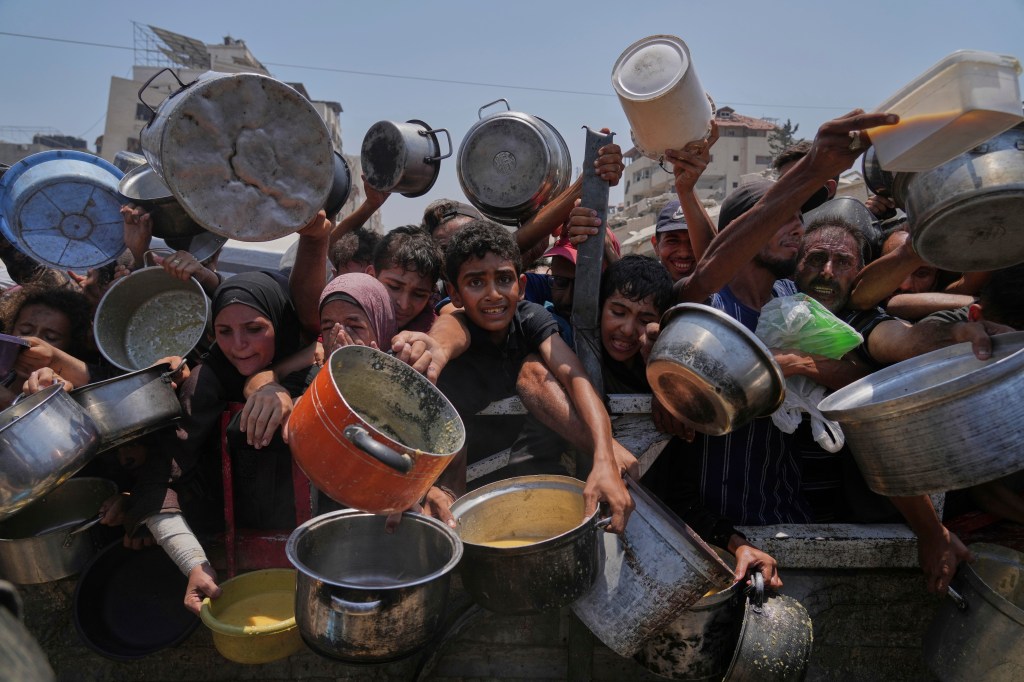
What took so long? Several Sunday shows today featured questions about starvation in Gaza to the guests and whether the U.S. should be doing something about it. Finally.
Interviews from medical personnel on the front lines in Gaza have been posted online and airing in foreign news media all year. Just do a YouTube or Instagram search. But they have not been an A-block story in American television in a long while.
Several hosts on MSNBC and CNN have continued to report on Israeli bombings and supply blockades in Gaza. But for much of the mainstream media – the media watched by those who most consistently vote and bother their representatives when outraged (people who qualify for AARP), many other events have claimed the spotlight.
Those highlighted events include: passage of the bill with the awful name; the intentionally-cruel and often-unconstitutional treatment of migrants who illegally entered the country or overstayed their legal permission; trade wars that seem without purpose; epiphanies about Putin in Ukraine and hyperbole about total nuclear destruction in Iran; and now, the lack of transparency with the Jeffrey Epstein files and the potential of pardoning his convicted accomplice. So many headlines and not nearly enough of them about the starvation of people in Gaza as a strategy for defeating Hamas.
But the pictures taken by Western photographers and reports in the New York Times of nurses fainting on the job in the hospital for lack of food seem to be awakening…something. Will it be enough to get lawmakers to make different choices, with regard to assistance to Israel in the prosecution of this war, now that the U.S. has abandoned participation in the ceasefire talks? Will it make the administration pressure Israel to do something different, now that the world can see the outline of Palestinian children’s skeletons through their emaciated skin?
How does the world keep coming back to this place? How is it possible that there is a learning disability on the subject of inhumane treatment combined with what looks like racism?
It is inconceivable that nearly 60,000 White women and children could be starved anywhere on the planet and the United States of America wouldn’t do all it could to feed them or even effect regime change. But brown people, particularly ones who narrowly elected a terrorist organization to govern them, they are subjected to the argument that feeding them is really feeding the terrorists, because the terrorists will take the food. For the sake of argument, let’s say this is true. Fine. Then feed the terrorists too, but don’t starve an entire people as a tactic!
In the early 1990s, there were two main raging conflicts on the planet. One was in the former Yugoslavia, where the Bosnians and Serbo-Croatians were at war for territory and political control and killing each other horribly to get it. The United States sided with the Bosnian Muslims, sending military support by way of airstrikes on the Serbs and maintaining no-fly zones. Meanwhile, on a continent that was not Europe, Huti rebels spent approximately 100 days killing more than 500,000 Tutsi men (mostly). President Bill Clinton has said not intervening in the Rwandan genocide was among the biggest regrets of his presidency.
Is the comparison fair, between Rwanda and Gaza? In numbers, it is not, of course. But is it unrealistic to say the underlying pulse measurement for the U.S. government on whether to act in a foreign conflict is entirely unrelated to the ethnic identity of the innocent people getting kill? Sadly, I doubt it. And it’s about time more people in power acknowledge the connection and care.
What is taking so long?
Responses to “7/27/25”
-
The neurosis of white supremacy is an all encompassing denial of the equal humanity of brown and Black people, accompanied by an absence of empathy. If you don’t feel any basic connection to a people because you don’t see their humanity, or if don’t believe in the intrinsic value of their lives as human beings equal to you on this planet, then it’s easy to turn away while they die. Perhaps it’s a bit harder to deny the humanity of children…but not by much apparently. Otherwise we wouldn’t need to ask, “What is taking so long? “
LikeLike


 Quips & Clips
Leave a reply to Blackbird Cancel reply